
Sipowered byAisports intelligence
What people actually use Ribby for.
Five jobs, one page each. Every one below shows the real screen, a conversation with real players and real numbers, and the one move that job teaches — the product doing the thing, right here, no demo to load.
The card shows you every number. Ribby tells you which one matters this week.
See how it works → Set your lineupThe card shows the lineup. Ribby checks the injury report before you set it.
See how it works → Work the wireThe page finds the hole. Ribby tells you whether the wire can fill it — or says it can’t.
See how it works → Grade a tradeThe desk grades the deal. Ribby tells you whether the other side would actually say yes.
See how it works → Build a DFS lineupThe lab builds the lineup. Ribby builds the stack — and the desk grades itself after every slate.
See how it works →A week with Ribby
Tuesday to Sunday, one job a day.
This is the rhythm a fantasy week actually has — and the page that does each part of it.
Waivers clear tonight. The page has your thin spots read and the adds that fill them priced; Ribby tells you the one move — or that the wire is quiet.
Work the wire →Wednesday02Make the call you’ve been avoidingNeedle Movers has searched every rival roster. Ribby grades the deal both ways and writes the message you send.
Grade a trade →Thursday03Open the file on anyoneThe card on every player in the league: the market, the rank, the usage, the news. Ribby reads it and tells you which number matters this week.
Research a player →Sunday morning04Set it, then check itThe optimizer has every legal lineup priced. Ribby checks the injury report and the news on every seat with a tag, names who covers whom, and signs it — or changes one seat and says why.
Set your lineup →Sunday, 12:5505The DraftKings slateThe pool priced, the lab built, the sim run, the late swap ready. Ribby builds the stack; the desk grades itself after the games.
Build a DFS lineup →01 · Research a player
Ask about any player. Get the whole file.
Where he ranks, what he did every week, how the ball actually finds him, who is hurt around him, and what the beat writers said this morning — one card, and a best friend who read all of it before you finished typing.
The card shows you every number. Ribby tells you which one matters this week.
Market rank from three sources with their own numbers, his points per game against every player at his position, the weekly log, usage trend, boom/bust, and a designation line that says how OLD the report is.
He opens the same card, pulls the injury report and the news on anyone with a designation, and says what it adds up to — in a sentence, with a Call.
Not just yours. Any name in the NFL pool opens, with whether he is free in your league, rostered by a rival, or already yours.
Back?! He never LEFT, he just took a two-week nap. Since he came back in Week 4 he has been the most targeted man alive — 24 targets and 138 yards against Buffalo, a 44% share, and a 48% share last week against the Chargers. That is 23.1 points a game on a 6-game sample, and the Rams are 5.5-point favorites at Washington on Sunday with a 47.5 total.

02 · Set your lineup
The card picks the lineup. Ribby checks it.
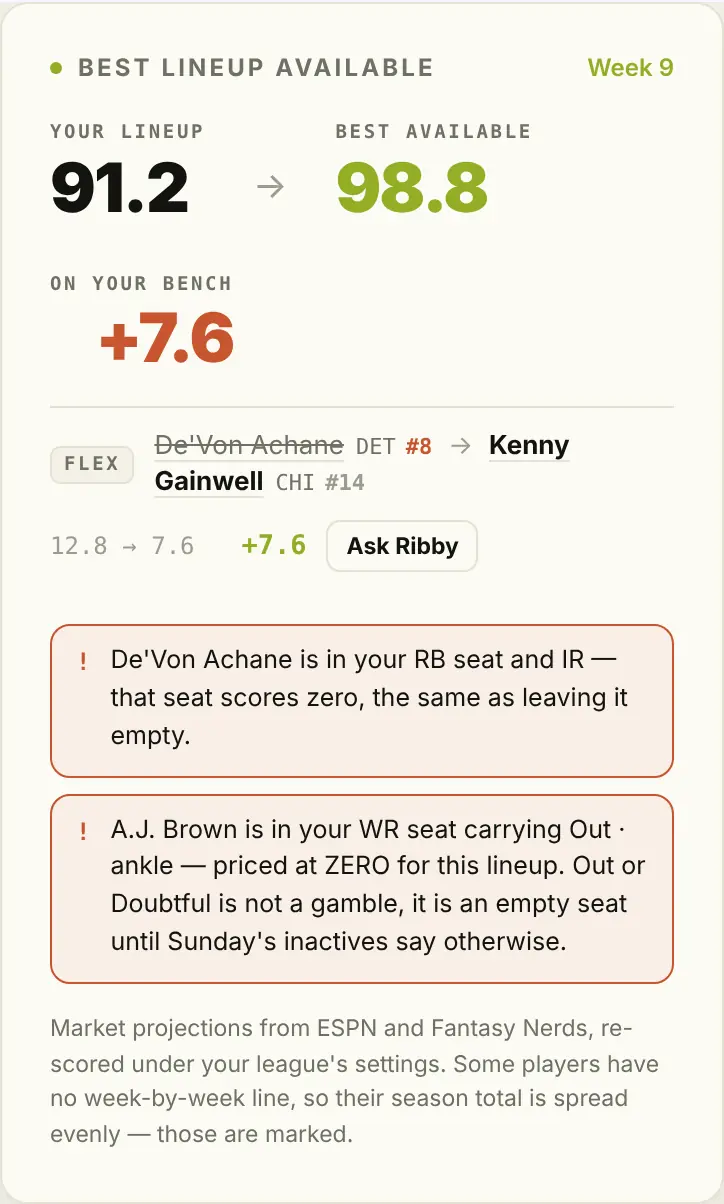
An exact optimizer runs every legal arrangement of your roster under your league’s own scoring and shows the changes from the lineup you have set. Then the part no optimizer does: Ribby reads the injury report and the news on every man with a designation before he calls a seat.
The card shows the lineup. Ribby checks the injury report before you set it.
Every legal lineup is priced, so a flex seat never strands a starter behind it. A change is reported as a change of personnel — never two men trading chairs for zero points.
Inside the measured noise, a swap is drawn as "either / or", not sold as a call. Outside it, the number is the number.
Ribby pulls the injury report and the news on anyone carrying a designation, names who covers a Questionable starter and whether that cover kicks off in time — and only then agrees, or doesn’t, in one sentence.
Tuten, and it isn’t a debate — because Pittsburgh is on BYE this week! Warren cannot score from his couch, my guy. Tuten, meanwhile, just went 104 rushing yards, a touchdown and a 55-yard catch against the Colts — 29.9 points! — and he plays Thursday night in Baltimore, so you have until 8:15 Thursday to get this right.
03 · Work the wire
The wire, read against what you’re short of.
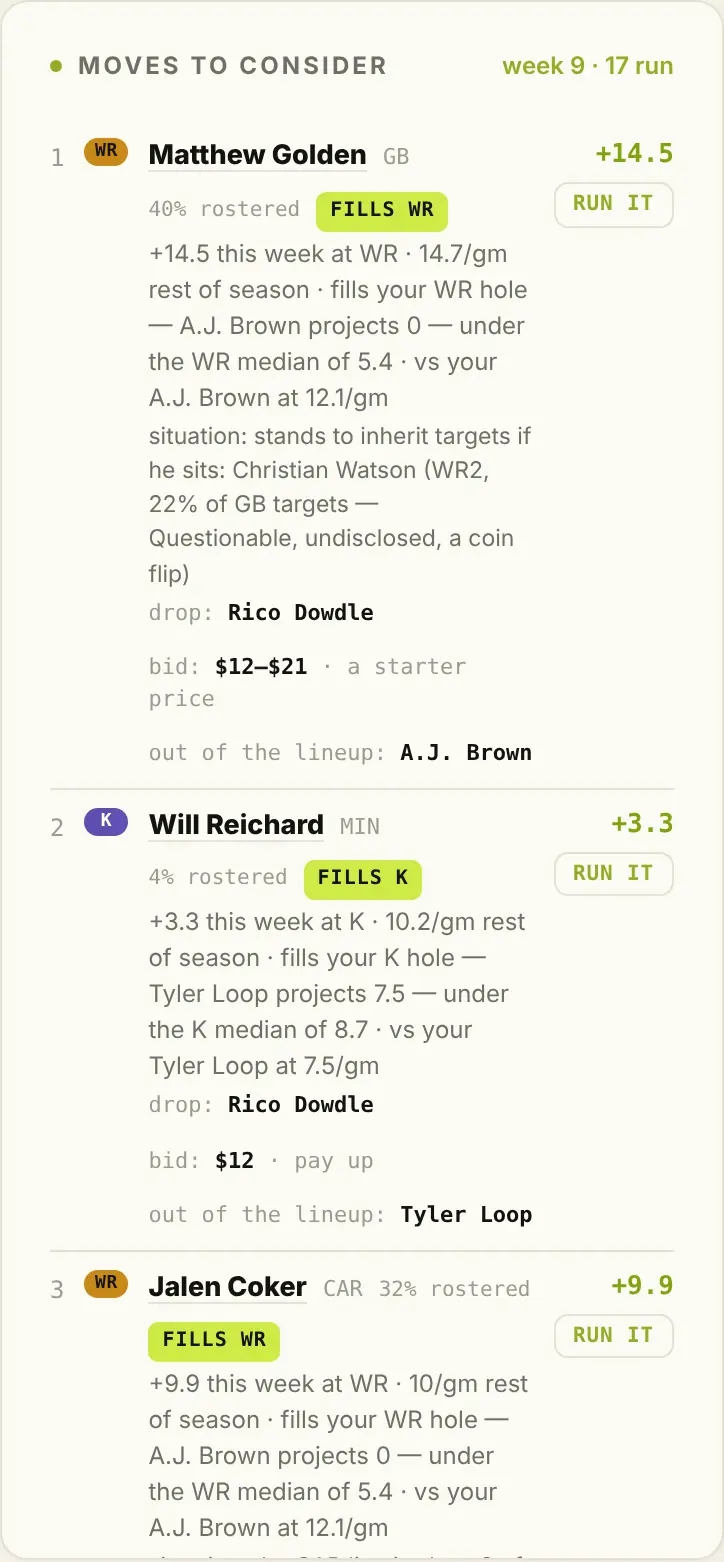
A pickup is measured against the hole in your lineup, not the top of a popularity list. Thin spots first, then the adds that actually fill them, with the drop named, the bye printed, and a bid priced off what your league really pays.
The page finds the hole. Ribby tells you whether the wire can fill it — or says it can’t.
An empty seat, a starter under his position’s league median, no healthy cover behind a dedicated seat, a bye with more starters out than bench to cover it. That is what "short" means here.
The gain is your best lineup with him minus without him — the exact optimizer again, never a value chart. The drop is position-aware and capped at the add’s own line.
FAAB bands are priced from your league’s own winning bids this season, or not offered at all. Ribby never guesses what a stranger’s league pays.
Because he missed Weeks 1 and 2 and somebody panicked, and now you get to profit from their panic! Since he came back he has been a WR1 wearing a tight end jersey — 10 targets, 92 yards and TWO scores against the Jets last week on a 40% share, 20.6 points a game across six games. That is the TE2 in football sitting in your free-agent pool like a lost wallet.
04 · Grade a trade
Both lineups rebuilt. Both sides shown.
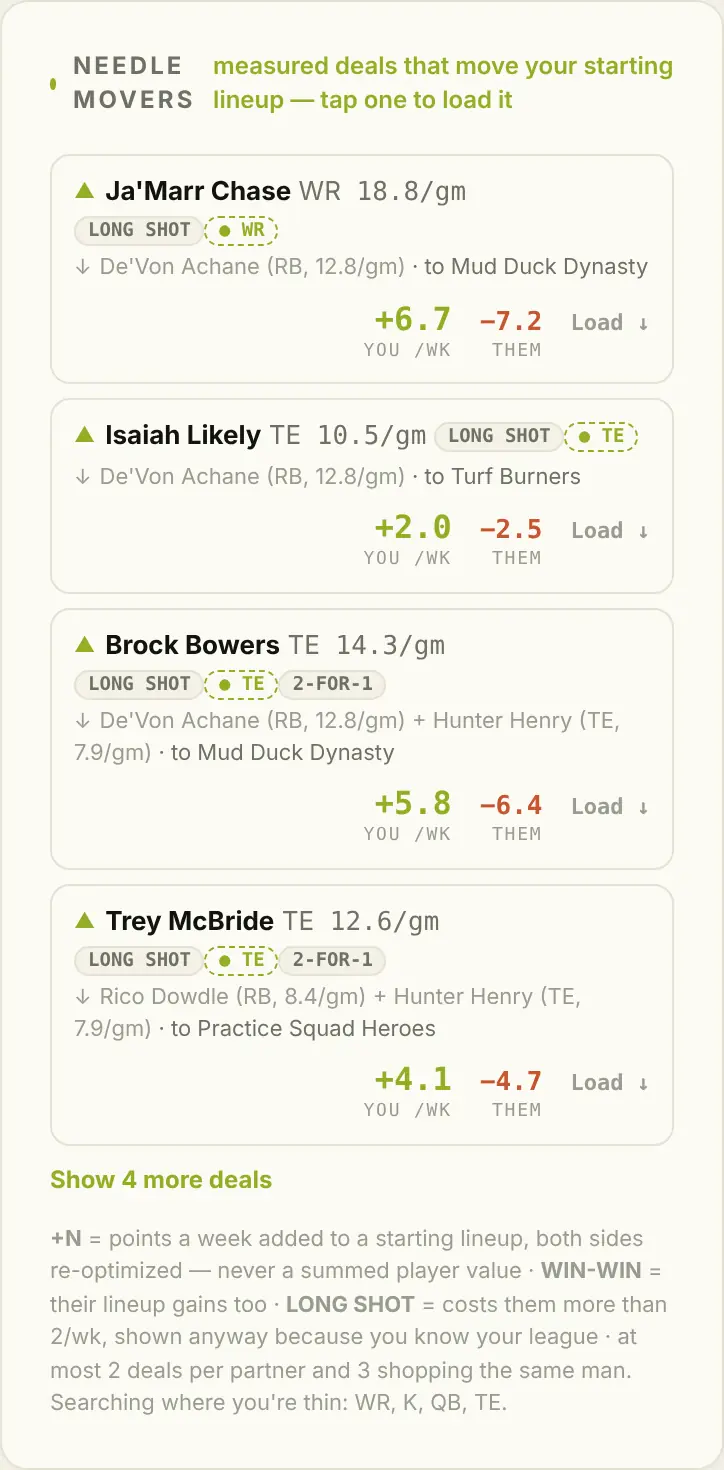
A trade is graded the only way that survives contact with a real roster: each side’s starting lineup is re-optimized after the deal and the difference is priced, for you and for them. If their side goes up and yours goes down, that isn’t a trade.
The desk grades the deal. Ribby tells you whether the other side would actually say yes.
The league page’s trade targets, the trade page’s Needle Movers and Ribby’s own read all come off one load and one grade, so the deal a card names is the deal the page grades is the deal he argues.
Every rival roster is priced once; the deals that move your weekly number are found, not guessed — a man who would start for you and whom they would not miss.
A lopsided row is named as one and never counted toward the offers you asked for. Fewer fair offers than you wanted means the real count and why.
No. NO. Absolutely not, and I’m a little offended on your behalf! Walker is the RB2 in football — 22.9 a game, 770 rushing yards and 6 scores in seven games, plus 22 catches. Henry’s name is still enormous, but his October was 5.0, 5.9 and 14.0 — three straight weeks under what Walker averages. He is trying to sell you last year’s jersey at this year’s price.
05 · Build a DFS lineup
The slate, priced. The lineup, built. Then graded.
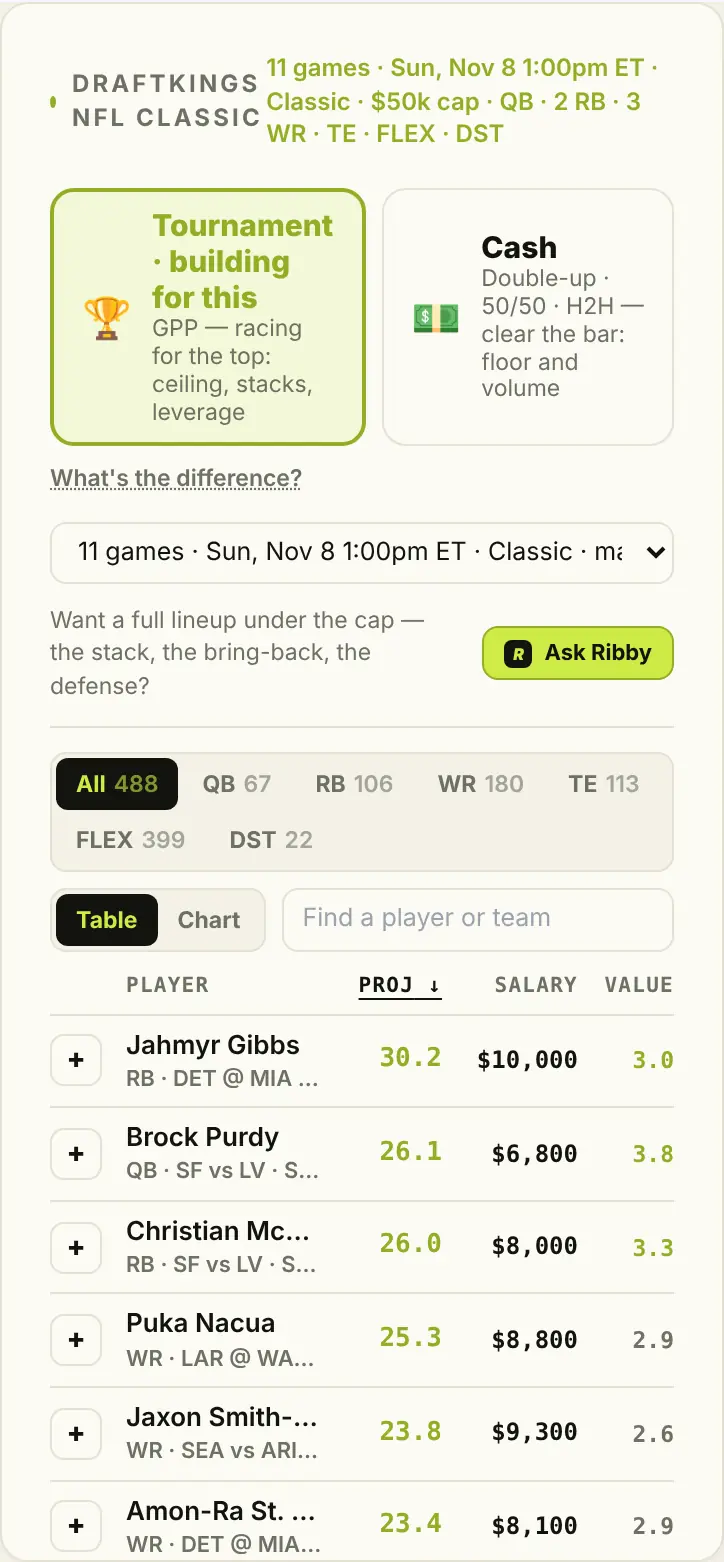
Ribby Daily is a dedicated DraftKings analyst: the pool with salaries and projections, Vegas lines and props, weather, a lineup lab, a simulator built on the correlations we measured, and a late-swap tool — with every projection logged and scored against the real result after the slate.
The lab builds the lineup. Ribby builds the stack — and the desk grades itself after every slate.
Every DraftKings player with salary, projection and value, by position, as a table or a salary-vs-projection chart. A "+" seats him in the lab; the cap turns red when you blow it.
Outcomes are drawn from the residuals our own graded projections produced, with the within-game correlations we measured on real player-weeks — the stack, the bring-back, the defense against the opposing quarterback.
Every projection is logged the moment it is made and scored against the actual DraftKings result. The report card is inside the product and on our statistics page, misses included.
Tournaments are won on correlation, so we start with the game that can’t stop scoring: Bengals at Falcons, 52.5 total — the highest on the slate — at 9:30 in the morning in London. Joe Burrow just hung 39.5 on Tennessee, Chase went 141 yards and Higgins 155 with two scores in the same game. A quarterback and his pass-catcher move together — we measured it at +0.23 on real graded weeks — and the bring-back from Atlanta is Bijan or Drake London. The defense NEVER faces my own offense, in either direction; that rule has no exceptions and no feelings.
Straight answers
The questions people ask before they start.
Do I need to connect a league to use Ribby?
For the season-long coach, yes — every answer is about YOUR roster, wire and opponents, and the connection is read-only and takes about a minute (ESPN, Yahoo or Sleeper). Ribby Daily, the DraftKings desk, needs no league.
Are the conversations on these pages real?
The players and the numbers are real 2026 lines read off our own database and dated on every page; the conversations are scripted so the site needs no login to show them. On your league, Ribby generates every answer live from your data.
What does a question cost?
A plan comes with a monthly allowance of Ribby Tokens. A question is one token; a Daily lineup build draws more, and the price is shown on every Daily door. The free trial is ten tokens on your own league.
Does Ribby make things up?
No. Every number he says is in our database; when something genuinely is not there, he says so. His earlier calls are stood by or withdrawn in one line, never denied.
Bring your league
Pick a job. Do it tonight.
Connect your league read-only in about a minute and every screen on this page computes for your team.
Screens: the sample league as of Nov 3, 2026. Chats: real players, real 2026 lines through Week 8 as of Nov 3, 2026.